
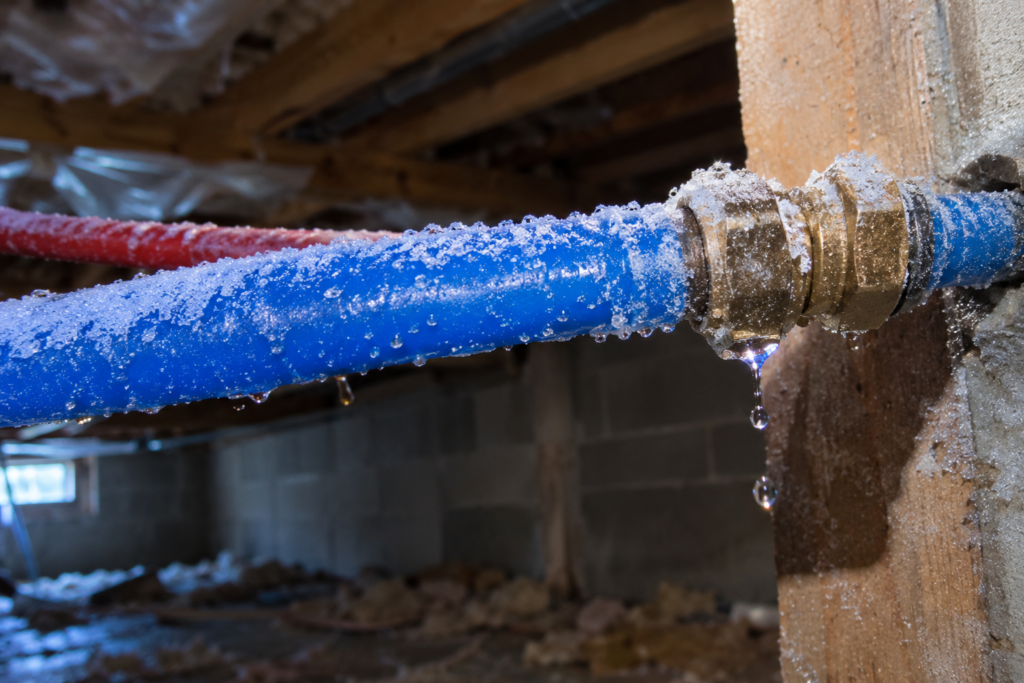
If you’ve had your home replumbed in the last 15 years or so, there’s a good chance you have PEX pipe. Plumbers love it, builders love it, and plenty of salespeople will tell you it “can’t burst.” Here in Rockford, where January nights regularly drop below zero, that claim deserves a closer look.
The short answer: PEX is more freeze-resistant than copper or PVC, but it is not freeze-proof. It can still split, and when it does, you could be dealing with a lot of water in a very short time. Let’s walk through how it works, where PEX actually fails, and what you can do before the next cold snap.
What Is PEX Pipe, Anyway?
PEX stands for cross-linked polyethylene. It’s a flexible plastic tubing used for hot and cold water lines in homes. It comes in red, blue, and white, and it’s usually run in long, continuous lengths with fewer joints than old-school copper.
That flexibility is the whole reason people say it resists freezing. Unlike rigid copper, PEX has some give. When water inside turns to ice, the pipe can expand a bit instead of cracking right away.
So, Can PEX Freeze?
Yes. Water freezes at 32°F no matter what pipe it’s sitting in. PEX doesn’t have any special power to keep water liquid. It just handles the aftermath better than most materials.
When water turns to ice, it expands by roughly 9 percent. In a rigid pipe, that expansion has nowhere to go, and the pipe splits. PEX can stretch to absorb some of it. Many homeowners go through a freeze, thaw out, and find the pipe is perfectly fine.
But “often fine” isn’t the same as “always fine,” and that’s where people get burned.
Can PEX Burst? Yes, and Here’s When
Here’s the part the sales pitch leaves out. A frozen pipe doesn’t burst because of the ice itself. It bursts because of pressure. When ice forms a plug in the line, water behind that plug has nowhere to go. Pressure builds between the ice and the closed faucet, and something eventually gives.
With PEX, a few things tend to give first.
The fittings. This is the big one. PEX tubing flexes, but the brass, plastic, or copper fittings connecting it do not. Elbows, tees, manifolds, and shutoff valves are the weak points. The tubing may be fine while a fitting cracks or gets pushed apart.
Repeated freezing. One freeze might not hurt a PEX line. Several freeze-and-thaw cycles in the same winter can stretch the tubing past its limit, weaken it, and cause a slow leak later that you won’t notice until a ceiling stain shows up.
Extreme or prolonged cold. A few hours at 25°F is one thing. Several days of subzero temps in an unheated space is another. At some point even flexible tubing runs out of room to stretch.
Poor installation. Pipes that are kinked, pulled too tight, or pressed against cold exterior surfaces are more likely to fail.
So can PEX burst? Absolutely. It just takes a bit more cold, or a weaker spot, to make it happen than it does with copper.
Where PEX Freezes in Rockford Homes
If you’re not sure where your risk is, start with the spots that get the coldest. In our area, these are the usual suspects:
- Pipes in exterior walls, especially on the north side
- Unheated garages
- Crawlspaces with open vents or poor sealing
- Attics and rooms over garages
- Lines near rim joists in the basement
- Outdoor hose bibs and the pipes feeding them
Older Rockford homes that were retrofitted with PEX are especially worth checking. The plumbing might be new, but the walls and crawlspaces around it are not. Gaps in old insulation let cold air reach the pipes, even if the rest of the house feels cozy.
If your crawlspace is the trouble spot, our crawlspace water damage cleanup team sees frozen-line damage down there more often than people expect.
How to Protect PEX Pipes Before It Gets Cold
The good news is that prevention is cheap compared to cleanup. Here’s what actually works.
Insulate exposed lines. Foam pipe sleeves cost a few dollars and go on in minutes. Focus on anything in an unheated area.
Seal air leaks. Cold drafts near pipes do more damage than the outdoor temperature alone. Caulk or foam around where lines enter the house, and seal gaps near rim joists.
Keep the heat on. If you’re traveling in winter, don’t drop the thermostat below 55°F. Saving a few dollars on the heating bill isn’t worth a flooded house.
Open cabinet doors. On very cold nights, open the doors under kitchen and bathroom sinks, especially on exterior walls, so warm air can reach the pipes.
Let faucets drip. A slow trickle keeps water moving and relieves pressure. It doesn’t have to be much. Just enough to keep it from sitting still.
Disconnect hoses and shut off exterior bibs. Drain outdoor lines before the first hard freeze.
Know where your main shutoff is. Everyone in the house should be able to find it in the dark. When a pipe lets go, the next 60 seconds matter a lot.
What to Do If a PEX Pipe Freezes
If you turn on a faucet and nothing comes out, or just a trickle, you may have a frozen line. Don’t panic, and don’t grab a torch.
- Open the faucet so water can flow as the ice melts.
- Apply gentle heat. A hair dryer, heating pad, or warm towels work well. Never use an open flame, since PEX is plastic and it will melt or burn.
- Work from the faucet back toward the frozen section.
- Check for leaks once water starts flowing again. Look at fittings and joints first.
If you can’t find the frozen section, it’s behind a wall, or you see any bulging or cracking, shut off the water at the main and call for help.
What to Do If It Bursts
Burst pipes don’t announce themselves politely. You might hear water running inside a wall, spot a wet ceiling, or walk into a damp basement. Here’s the order to follow:
- Shut off the main water valve immediately.
- Turn off power to affected areas if water is near outlets or appliances. Only do this if you can reach the panel safely.
- Open faucets to drain the remaining water in the lines.
- Move belongings out of the wet area if it’s safe.
- Take photos and video for your insurance claim.
- Call a professional right away.
Water moves fast. Within a day, it can soak into drywall, subfloors, and insulation, and mold can start to grow within 24 to 48 hours. Our burst pipe damage cleanup crew can be at your door within 60 minutes, any hour of the day. If you’re not sure who to phone first, we put together a simple guide on who to call for water damage in Rockford.
Sometimes the break is in the line coming into the house rather than inside it. That’s a different repair, and our main water line break repair service covers it. For a split pipe inside the walls or floors, water pipe break repair and cleanup is usually the right starting point.
The Hidden Damage People Miss
Here’s something we see all the time. The pipe gets repaired, the visible water gets mopped up, and everyone assumes it’s over. A week later there’s a musty smell, or paint bubbling on a wall.
Water spreads. It wicks up drywall, runs along joists, and settles into insulation where you can’t see it. That’s why professional structural drying and dehumidification matters. Fans from the hardware store won’t pull moisture out of a wall cavity.
If you’re worried about what’s behind the walls, read our article on mold after water damage in Rockford. And if a slow leak is the issue instead of a sudden burst, pipe leak detection can pinpoint it without tearing open half your house.
When the water ends up downstairs, our guide on what to do first when your basement floods walks you through the first few hours.
Is PEX Still a Good Choice?
Honestly, yes. For most homes, PEX is a solid, affordable material, and it does hold up to cold better than copper. Plenty of homeowners get through brutal winters with no trouble at all.
Just don’t treat it as a free pass. Insulation, air sealing, and a little attention during cold snaps are what keep it safe. Think of PEX as giving you a bigger margin for error, not no margin at all.
Final Thoughts
So, will PEX pipe freeze and burst? It can freeze, and it can burst, especially at the fittings or after repeated freezes. It’s tougher than copper, but a Rockford winter is tougher than most plumbing.
Take an hour this fall to check your crawlspace, garage, and exterior walls. Add insulation where you need it, and make sure everyone in your household knows where the main shutoff is.
And if the worst happens, don’t wait. Call 24/7 Restoration Experts at (815) 324-8004, or contact us online for a free inspection. We serve homes across Rockford and the surrounding communities, and you can see the full list on our areas we serve page.
Leave a Reply